Online Rent Collection
How to collect rent online with Seayora — setup, payment methods, card surcharges and where state law limits them, records, and how funds move.
Online rent collection replaces checks and cash with automatic payments, instant records, and fewer late payments.
Setting it up
Add your property and lease, invite your tenant, and set the rent amount and due date. Tenants link a bank account or card and can enable autopay. You’re notified when a payment is initiated and when it settles.
Pet rent, parking, storage and other monthly charges
Recurring charges on the lease are collected with the rent, in the same payment and on the same due date: pet rent while the lease allows pets, parking while it allots a space, storage, and any other fee you set as monthly. A month shorter than a full month prorates them the same way as the rent. One-time fees, such as a move-in fee, are not part of the monthly charge.
Each month is itemized for the tenant, for example “Rent $2,400.00 · Parking $75.00”, on the website and in both phone apps. The lease states every one of these amounts, and Seayora will not send a lease for signature if it bills an amount the document does not state. Changing one of them on a signed lease updates the months that have not been charged yet, and the tenant is emailed about the change.
Payment methods and processing
Payments are handled by our payment processor. ACH bank transfer is usually the lowest-cost method; cards are also supported. Seayora does not store full card numbers.
Records
Every payment is timestamped and exportable, which makes bookkeeping and tax season far easier and gives both sides a clear paper trail.
Finding a charge
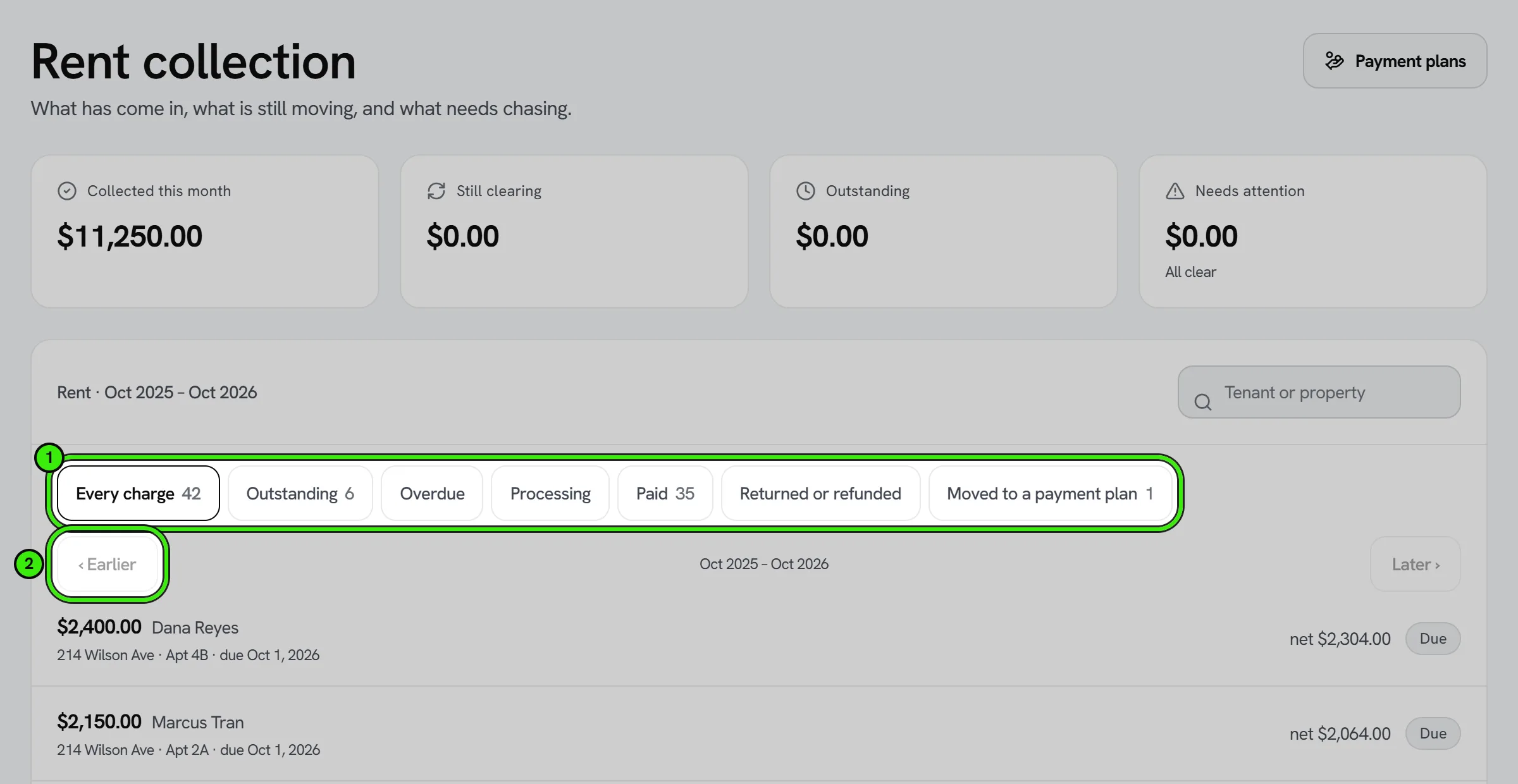
Rent collection shows twelve months at a time, from next month's upcoming charges back a year; Earlier and Later step through the history. The filters above the list — Outstanding, Overdue, Processing, Paid, Returned or refunded, Moved to a payment plan, Plan installments, Roommate shares, and charges with pet rent, parking or utilities — each show how many charges they hold in those twelve months. Outstanding and Overdue are the exception: an unpaid charge is shown however old it is, because it is still owed. The same filters and pages are on the website, the iPhone and Android.
Partial payments and payment plans
A resident who cannot pay a month in full can ask to spread it, and you decide. The schedule, the signed agreement and what happens if an installment is missed are all handled in Seayora — you do not have to document it separately. See “Payment Plans for Rent You Cannot Pay in Full”.
What tenants see on their end
Tenants get a simple view of what’s due, when, and a history of what they’ve paid — reducing “did you get my payment?” messages and giving them the same transparency landlords have.
Paying by card: the surcharge and where it is not allowed
Bank transfer (ACH) is always charged at par. A card payment carries the processing cost as a surcharge, quoted in full — as a total — before the tenant chooses, and the charge uses the same figure the quote showed. The surcharge pays the card network’s cost of that payment, which Seayora carries, so it goes to Seayora with the processing fee: the landlord receives the same amount whether the tenant pays by bank or by card. Three rules are enforced automatically, based on the state the property is in (not the payer’s address):
- Where state law prohibits card surcharges, the card option is not offered for that property and the tenant pays from a bank account. Seayora does not absorb the cost instead.
- Where state law caps the surcharge, a card is offered only when the pass-through cost on that payment fits under the cap; otherwise the tenant is told why and pays by bank transfer.
- Debit and prepaid cards are never surcharged (card-brand rules and the Durbin Amendment). A card the payment processor reports as debit is charged at par.
| State | Rule enforced | Authority |
|---|---|---|
| Colorado (CO) | Surcharges are capped at 2% — a card is offered only when the pass-through cost on that payment fits under the cap. | C.R.S. § 5-2-212 |
| Connecticut (CT) | Card surcharges are prohibited — the card option is not offered for properties in this state; rent is paid from a bank account. | Conn. Gen. Stat. § 42-133ff |
| Maine (ME) | Card surcharges are prohibited — the card option is not offered for properties in this state; rent is paid from a bank account. | 9-A M.R.S. § 8-509 |
| Massachusetts (MA) | Card surcharges are prohibited — the card option is not offered for properties in this state; rent is paid from a bank account. | M.G.L. c. 140D, § 28A |
| Minnesota (MN) | Surcharges are capped at 5% — a card is offered only when the pass-through cost on that payment fits under the cap. | Minn. Stat. § 325G.051 |
| New Jersey (NJ) | A surcharge may not exceed the actual cost of processing. The surcharge is an exact pass-through of the configured cost. | N.J.S.A. 56:8-2.33 |
| New York (NY) | The total card price must be shown before checkout. The quote shows it. | N.Y. Gen. Bus. Law § 518 |
Seayora may add states to the blocked list; it cannot remove a statutory one. This describes how the product behaves and is not legal advice. Where a surcharge is unlawful, a landlord who still wants to accept cards can only do so by having the processing cost absorbed, which is not the platform default — talk to us.
Frequently asked questions
What payment methods can tenants use?
ACH bank transfer and card payments are both typically supported. ACH is usually the lowest-cost option and is often the default recommendation for recurring rent.
Are pet rent and parking collected separately from the rent?
No. Recurring monthly charges on the lease are added to the rent charge and collected in the same payment, itemized so the tenant can see each amount. A one-time fee, such as a move-in fee, is not part of it.
How quickly does the landlord get notified of a payment?
You’re notified as soon as a payment is initiated and again once it fully settles, so you always know where a payment stands rather than waiting for a bank statement to confirm it.
Can a tenant pay rent for someone else, like a roommate?
Depending on how the lease and account are set up, a tenant can often cover the full rent themselves, or each tenant on a lease can pay their own portion — check your lease’s payment setup.
Can I collect rent for a unit I manage but don’t own?
Yes — as a management company or agent, you can collect on behalf of an owner as long as you’re authorized to do so and the payout routing is configured correctly for that owner.
Related guides
- Payment Plans for Rent You Cannot Pay in Full
- Autopay & Automated Reminders
- Splitting Rent with Roommates
- Fees, Payouts & Refunds
- Rent-Payment Credit Reporting
Related features and guides
- Payment Plans for Rent You Cannot Pay in Full — Documentation. How a resident asks to spread a month’s rent — or is offered one — how the schedule can be shaped, how a landlord decides it, what the signed agreement says, when a date can be moved, and exactly what happens if an installment is missed.
- Autopay & Automated Reminders — Documentation. How autopay and scheduled reminders reduce late rent, and how to configure late-fee policies.
- Splitting Rent with Roommates — Documentation. How roommates on one lease each pay their own share, what it costs, how a late share is handled, and how each roommate’s payments are recorded and reported.
- Online Rent Collection Software — Feature. Online rent collection: bank transfers free to the tenant, card payments, AutoPay on the lease’s due date, automatic late fees, roommate splitting and receipts issued when rent settles.
- How to Collect Rent Online: A Landlord’s Guide — Guide. A practical guide to setting up online rent collection — the benefits, how autopay and reminders work, and what to look for in a rent payment platform.
- Security Deposit Handling — Feature. Collect deposits through the platform, keep them tied to the lease and the unit, and back any deduction with dated move-in and move-out evidence.