Before you file: the checks Seayora runs, and why some of them are our fault
Seayora refuses to open an eviction case while something would sink it — an unanswered payment plan, money still settling, a grace period that has not run, open repairs, a subsidized tenancy. Several of the blockers are Seayora’s own problem rather than the resident’s, and each is cheaper to find here than in a courtroom.
Before a case can be opened, Seayora runs an assessment on the tenancy and lists everything standing in the way. The list is the most valuable screen in this feature, because a filing fee is spent whether or not the case survives, and a case dismissed on a technicality has to start again from the notice.
What stops a case, and why
| Blocker | Why it stops the case |
|---|---|
| Nothing is outstanding | The arrears are recomputed live. There is nothing to bring. |
| A payment is still settling | ACH takes days. Filing against money that is already on its way is a case you lose and a customer you keep having to apologize to. |
| The grace period has not run | Rent is not late until your own lease says it is. The lease governs, and Seayora reads it rather than assuming. |
| There is an open payment plan | A signed forbearance is an agreement. Filing while one is running is a defense handed to the other side. |
| No payment plan has been offered | Your own setting, on by default. A signed plan costs nothing, is enforceable, keeps a paying resident, and is the first thing a diversion court asks whether you tried. |
| Your payout account is not approved | This one is ours. Rent could not be collected because the account was never finished — which from the owner’s side looks exactly like a resident who will not pay. |
| The payment method needs relinking | Also ours. A processor change broke the saved method and the charge never had a chance to succeed. |
| There are open repairs | In most states an unremedied habitability problem is a counterclaim, and in several it is a complete defense to a nonpayment case. |
| It is a subsidized tenancy | A housing program has its own procedure and its own notice requirements, layered on top of the state’s. |
| The jurisdiction is unverified | Seayora holds no statute for this state. It will not invent a process. |
| Below your own threshold | Your settings say not to start below an amount or before a number of days late. |
Two of these are Seayora’s fault and we say so
A payout account that never finished onboarding, and a payment method the processor change broke, both produce the same thing from a landlord’s side: rent that did not arrive. Neither is the resident’s doing. Both are named as our problem, with a link to fix them, rather than being folded into a general “rent is unpaid” — because starting a legal proceeding against somebody over money our own plumbing failed to collect is the worst outcome this product could produce.
A blocker is not always a refusal
Some of these are advisory. Open repairs are a warning: you can proceed, and you should know that you are proceeding. Others genuinely refuse — Seayora will not open a case on a jurisdiction it holds no verified rule for, because the alternative is a checklist of invented steps with invented deadlines.
Your own rules
Under “Your eviction rules” you set when Seayora will let a case be opened at all: a minimum amount, a minimum number of days late, and whether a payment plan must be offered first. You can also record your attorney’s details and how you usually have papers served. The settings apply to new cases; a case already running is not changed by editing them.
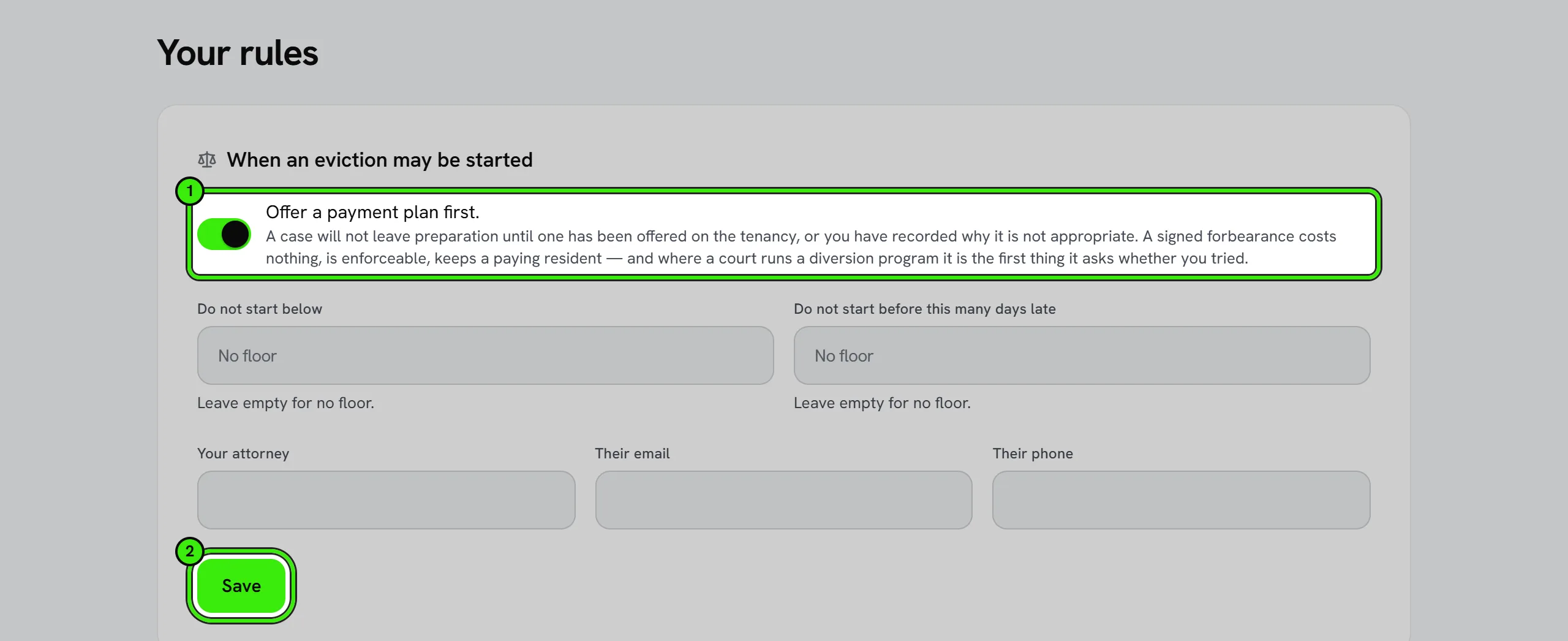
The payment-plan requirement is on by default, and it is a real gate rather than a suggestion. This is the cheapest intervention available in the whole process, and where a court runs a diversion or mediation program, whether you offered one is a question you will be asked.
Frequently asked questions
Why will Seayora not let me open an eviction case?
The assessment lists the reason. The commonest are: the balance has been paid or is still settling, the lease’s grace period has not run, there is an open payment plan, no payment plan has been offered where your settings require one, there are open repair requests, or Seayora holds no verified rule for that state. Each names what would clear it.
Do I have to offer a payment plan before evicting?
Seayora requires it by default, and you can turn that off in your eviction rules. Whether the law requires it depends on where you are — a number of cities operate mandatory diversion or mediation programs, and a case filed without attempting one is dismissed. Where Seayora holds that rule for your city, it is a step on the case rather than a setting.
Can I still file if there are open maintenance requests?
Seayora will let you, and it warns you first. In most states an unremedied habitability problem gives the tenant a counterclaim, and in several it is a complete defense to a nonpayment case. It is worth closing the repairs before spending a filing fee.
The tenant paid part of what they owe. Can I still evict?
That depends on your state and on what the notice demanded, and it is one of the commonest ways a case is lost. Several states void a notice that demands more than the rent actually owed, and accepting a partial payment can waive the notice entirely. Seayora recomputes the arrears live so you can see what is actually outstanding, and this is a point to take advice on.
Related guides
- Eviction navigation — what Seayora does, and the four things it will never do
- How the steps and deadlines work — and why some steps deliberately have no date
- Payment Plans for Rent You Cannot Pay in Full
Related features and guides
- Eviction navigation — what Seayora does, and the four things it will never do — Documentation. Seayora navigates an eviction: the steps your state and city require, in order, each with the statute behind it, the deadline it sets and a link to the real court. It does not file, serve, evict, or give legal advice — here is exactly where that line sits and why it is drawn there.
- How the steps and deadlines work — and why some steps deliberately have no date — Documentation. Every step on a Seayora eviction case carries the statute behind it, whether it blocks the steps after it, and where its deadline comes from — statutory, set by the court, set by your lease, or an estimate. A step Seayora has not verified gets no due date at all, on purpose.
- Payment Plans for Rent You Cannot Pay in Full — Documentation. How a resident asks to spread a month’s rent — or is offered one — how the schedule can be shaped, how a landlord decides it, what the signed agreement says, when a date can be moved, and exactly what happens if an installment is missed.
- Accounts Receivable & Collections — Feature. Track outstanding balances across tenants and customers, age receivables, and run collections workflows before small arrears become large ones.
- Automated Late Fees — Feature. Set your grace period and late fee structure once — flat or percentage — and Seayora calculates and applies it automatically, with no uncomfortable conversations.
- Employee Tasks & Check-Ins — Feature. Assign tasks to staff, track completion, and require check-ins at site visits so field work is accountable rather than assumed.