Housing programs
Section 8, tax credits, exemptions and rent regulation — what each one requires, when it is due, and what it costs to be in it.
Housing programs are the subsidized and regulated side of a portfolio: the programs a building can be in, the paperwork each one requires, and the dates that paperwork is due. They live inside Compliance, on the website and on both phone apps.
Where everything is
Compliance has five sections — Violations, Filings, Programs, Carbon · LL97 and Checklist — and one Settings button at the top. A program’s deadlines and the paperwork in progress are under Filings, right below what the law asks of the building itself, so everything with a due date is in one place. What a building is enrolled in, and the programs it could join, are under Programs. Reminders are in Settings.
| What you need | Where it is | What it answers |
|---|---|---|
| Deadlines | Compliance → Filings | Everything due across your buildings, ordered by how close it is, with the consequence of missing each one. |
| Paperwork in progress | Compliance → Filings | One building, one agency, one filing — every document it needs and which are still missing. |
| Programs | Compliance → Programs | What each building is enrolled in, every program available where it is, and what each one obliges you to do. |
| Find programs | Compliance → Programs | Which of the programs available where you are would be worth applying for. |
| Reminders and billing | Compliance → Settings | When you are reminded and who is copied, and what the compliance fee is for each enrollment. |
On iPhone and Android, Compliance → Filings and Compliance → Programs open the Housing programs screen, which carries the same deadline board, packets, programs, forms and finder.
Statutory, estimated, confirmed
Every date carries its basis, and the difference matters more than anything else on the screen. Statutory means the date is fixed in law or regulation. Estimated means we derived it from the program’s cycle because the anchor it depends on — a placed-in-service date, a fiscal year end, a HAP anniversary — is something only your own contract knows. Confirmed means you checked it with the agency and told us.
An estimated date is badged everywhere it appears, including in the reminder email. Seayora will not present a date it derived as one fixed in statute, because an owner who commits capital against a wrong date has no way to discover the mistake until it is too late.
Reminders
Each lead you choose sends one reminder, once. An overdue filing sends exactly one more — a daily nag about something already missed trains people to ignore the channel.
| Setting | What it does |
|---|---|
| Lead days | How far ahead you are warned. One reminder per lead. |
| Email, alert, push | Which channels carry it. Email is the record. |
| Add to my calendar | Every deadline becomes a calendar entry that moves if the date moves. |
| Only remind me at or above | Quiets the advance warnings below a severity. It never silences the overdue notice. |
| Remind me on estimated dates too | Turn it off and the advance nudges on derived dates stop. You are still told once if one passes. |
| Escalate to | A second address, copied on anything inside the window you set and on anything overdue. |
Nothing you set here can silence an overdue notice. That is the one that costs money, so it is outside the preference.
Enrolling a building
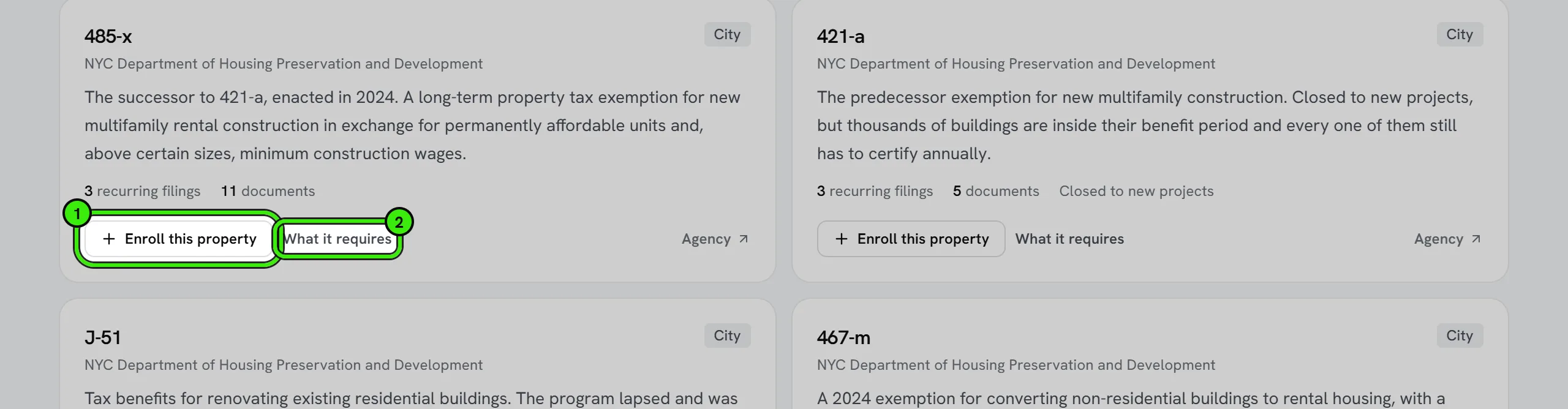
Enrolling puts the program’s obligations on your calendar and starts the compliance fee where one applies. The exact fee, in words, is shown before you agree to it and you have to accept it explicitly — and the same resolver produces both the quote and the charge, so the quote is the invoice.
A closed program is kept, not deleted
421-a is closed to new projects. Thousands of buildings are still inside it with live annual obligations, so the entry stays, marked as superseded, and its deadlines keep running.
What this is not
Seayora tracks these programs so you know what exists, what it requires and when it is due. It is not legal or tax advice, and the administering agency is the authority on eligibility, amounts and dates. Seayora packages a filing; it never certifies or submits one.
Related guides
Related features and guides
- Finding programs worth applying for — Documentation. Sixteen questions about a building, and a shortlist of the housing programs worth a phone call — with the reason for each.
- Building Health Score — Documentation. What the building health score is made of, what each factor means, what it deliberately does not claim, and how to show a building condition badge on a listing.
- Compliance — Documentation. Violations, required filings, housing programs and carbon caps for each building — what is open, what is due and what to do next.
- EV Charging for Tenants in California: When Landlords Must Say Yes — Guide. California Civil Code § 1947.6 requires many landlords to approve a tenant’s written request to install an EV charger, with exemptions, costs and insurance.
- Lead-Based Paint Disclosure for Landlords: Pre-1978 Rentals — Guide. Before leasing pre-1978 housing, federal law requires a disclosure, the EPA pamphlet and the Lead Warning Statement. Exemptions, records, and the RRP rule.
- Rent Autopay and ACH Debits: The Federal Authorization Rules — Guide. What Regulation E requires before rent is debited automatically: a signed authorization, a copy, stop-payment rights and notice when the amount changes.