Compliance
Violations, required filings, housing programs and carbon caps for each building — what is open, what is due and what to do next.
Compliance is where a building’s obligations live: what the City has on record against it, what the law asks it to file, the housing programs it is in, and its carbon cap. It is under Operations on the website and under Compliance on both phone apps.
How it helps
Choose a building at the top. Four figures sit under it — open violations, filings due, housing-program deadlines and open tasks — and each one opens the section it counts. Below them are five sections:
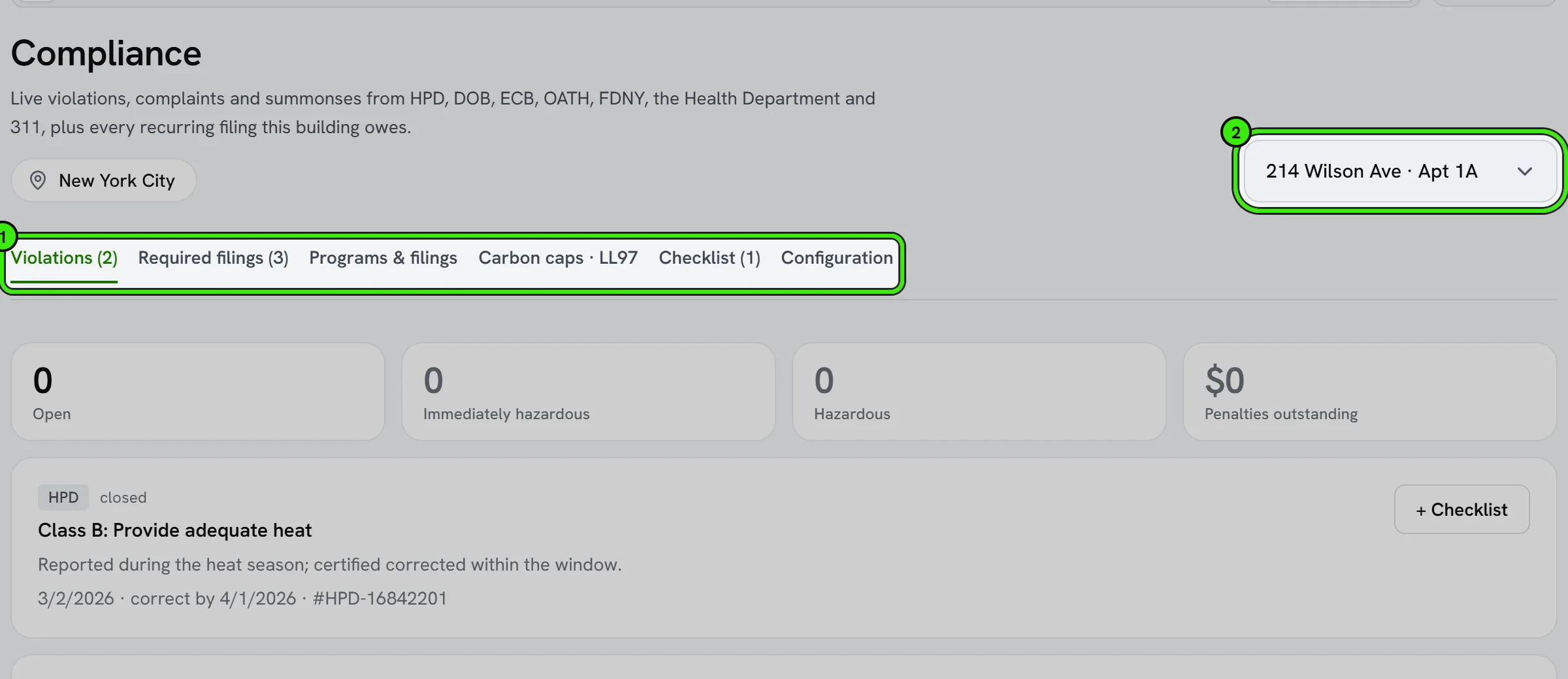
| Section | What is in it |
|---|---|
| Violations | Live violations, complaints, summonses and charges from the public records where the building is — New York City’s agencies, New Jersey’s state housing registry, the city records of Philadelphia, Pittsburgh, Buffalo, Syracuse, Chicago, Boston, San Francisco, Los Angeles, Montgomery County (Maryland), Hartford, Cleveland, Columbus, Cincinnati, Austin, Seattle, New Orleans and Kansas City (Missouri), and the New York, New Jersey and Connecticut environmental cleanup lists — with the feeds that were checked. A feed that did not answer is said, never counted as a clean result. |
| Filings | The registrations, inspections and certifications the law asks of this building, each with its due date and Mark filed — then the housing-program deadlines across your portfolio and the paperwork in progress. |
| Programs | What your buildings are enrolled in, every program available where the chosen building is, and Find programs. |
| Carbon · LL97 | Local Law 97 caps, penalty exposure and retrofit options across every New York City building you hold. |
| Checklist | What you have to close — added from a violation or by hand — with Start, Complete and Reopen. |
Settings
Everything you set up is behind Settings at the top of the page: which municipality governs the building, its BBL and BIN in New York City, which City feeds to watch, how and when to alert you, and the housing-program reminders. It used to be split between a Configuration tab and a second Settings tab inside Programs; it is one window now.
These tools assist you but don’t replace legal advice or official guidance. You remain responsible for meeting your obligations; confirm requirements with the relevant agency or counsel.
Which properties this applies to
Live violations come from the public records of the place the building is in — the places are listed below; everywhere else the Violations section says there is no live feed rather than showing an empty record. Required filings cover New York City, Westchester and Long Island, and every one of New Jersey’s 564 municipalities. Seayora works out the municipality from the building’s ZIP code and city; where a ZIP code crosses a municipal line — 07060 is partly Plainfield and partly North Plainfield — it asks which one rather than guessing, and you can always choose it yourself in Settings.
New York City
A New York City building is checked against twenty-one City feeds. Besides HPD, DOB, ECB, OATH, FDNY, the Health Department and 311, they include DOB’s safety civil penalties (boilers, elevators, gas piping, energy benchmarking, Local Law 97 and facades), HPD’s Alternative Enforcement Program, the emergency repairs HPD carried out and billed to the building, and the Department of Finance’s tax lien sale list. An HPD charge or a lien-sale listing says the building was billed, or that its debt was on that month’s sale list — the City’s data does not say whether it was then paid, so those items are shown with their amount and date but are never counted as open or resolved. If you saved your feed choices before November 2026, switch the new feeds on in Settings.
Energy and water use beside the neighborhood
Open a New York City building under Carbon · LL97 and scroll to Energy and water use (the Usage tab on the iPhone and Android). It sets the building’s own electricity, gas and water for its latest year beside three public figures: the average home account in its ZIP code, the median building in its ZIP code that reports to the City, and the average home across the state. The same panel appears on the free Local Law 97 lookup at seayora.com/features/ll97-compliance for any New York City address.
| Figure | Where it comes from |
|---|---|
| This building | Its own Local Law 84 benchmarking filing with the City (or the year you entered by hand), and the apartment count from the City’s PLUTO record unless you entered one on the building. |
| Homes in this ZIP code | The NY Utility Energy Registry published by NYSERDA: residential electricity and gas per account, for the last twelve months the utilities have reported. |
| Benchmarked buildings in this ZIP code | The median energy and emissions intensity of the buildings in the ZIP code that filed under Local Law 84, buildings of the same main use when at least ten of them reported. |
| Homes across the state | Monthly residential sales and customers published by the U.S. Energy Information Administration. |
Electricity per home is shown only for a building that is mostly apartments, and it is the whole building’s total — hallways, elevators, pumps and any shops included — divided by its apartments, so it usually reads higher than a single household’s bill. A figure a source did not publish says why (too few buildings to compare fairly, figures withheld to protect customers’ privacy, or a source that did not answer) and is never shown as zero. None of these figures changes the building’s emissions cap or penalty.
Other cities and states
These places publish their violations in a form Seayora reads live, matched on the building’s street address. Each answer says what its records do not cover — a Pittsburgh, Buffalo or Syracuse mailing address can be a suburb outside the city’s data, and there an empty list means nothing — and links to the place’s own records.
| Place | What is read |
|---|---|
| Philadelphia | Licenses & Inspections code violations, unsafe and imminently dangerous structures, and whether the building has an active rental license (a Philadelphia landlord needs one to collect rent). |
| Pittsburgh | Permits, Licenses & Inspections violations, including cases in court. |
| Buffalo | Code violations. |
| Syracuse | Code violations, and the list of structures unfit for human occupancy. |
| Chicago | Department of Buildings violations. |
| Boston | Inspectional Services violations, and Public Works code enforcement tickets with their fines. |
| San Francisco | Department of Building Inspection notices of violation. |
| Los Angeles | Open Building & Safety code enforcement cases, and Housing Department violations and cases. |
| Montgomery County, Maryland | Housing code inspections. |
| New York State and New Jersey | The state environmental lists — the DEC’s remediation sites and the DEP’s Known Contaminated Sites — matched on the address. A listing is an environmental obligation on the property (a cleanup, groundwater monitoring, a deed notice), not a fine. |
New items from these records become checklist tasks each night, and you are told about them by email or notification as your settings say. The first night a record is read for a building is a starting point: what is already open goes on the checklist, but you are not sent an alert for history.
New Jersey
For a New Jersey building with three or more units, the Violations tab reads the state’s own housing registry — the New Jersey Department of Community Affairs’ Bureau of Housing Inspection, which registers and inspects every such building in the state. It shows the building’s state bills and what is still owed, any docketed judgments, the next inspection and when it is due, and past inspections with the number of violations cited, with a link to the state’s record. Seayora finds the building by its address; if it finds the wrong one, or several, enter the 10-digit DCA registration number in Settings. One- and two-family homes are not in the state registry, so for those the tab says so rather than showing an empty record, and a municipality’s own code violations are never in it. The DEP’s Known Contaminated Sites List is checked for every New Jersey address as well.
No New Jersey municipality publishes its own code violations in a form Seayora can read, so for local rules the Filings section carries the work. It holds three kinds of item, and each one links to the rule it comes from:
- State law that applies everywhere in New Jersey: the landlord registration statement, the DCA registration and inspection of buildings with three or more units, the lead-safe certificate for homes built before 1978 (valid three years since 2024) and the copy attached to each new lease, the smoke alarm, CO alarm and fire extinguisher certificate before a new tenant in a one- or two-family home, Truth in Renting, the flood risk notice before every lease and renewal, the liability insurance certificate registered with the municipality each year, security deposit interest, and window-guard notices and inspections.
- Rent control, for the 120 municipalities that have it, in the words of the New Jersey Department of Community Affairs’ 2026 Rent Control Survey: which buildings it covers, the increase limit, the exemptions and the office to call.
- Local rules Seayora read in the municipality’s own code for 46 of the larger cities and towns — among them Newark’s registration and Certificate of Habitability, Paterson’s re-rental approval, Edison’s January 15 registration and reoccupancy inspection, Woodbridge’s certificate of rental housing compliance, New Brunswick’s April 1 registration, Elizabeth’s March 1 rent control registration, Union City’s tenant certificate 14 days before a move-in, Toms River’s rental certificate of occupancy (whose current three-year term ends December 31, 2026) and Montclair’s April 1 rent registration — each with the date it was read. Elsewhere in North and Central Jersey, Seayora points to the chapters of the local code that deal with rental registration or a certificate before a new tenant, and says plainly that you should open them to confirm what they require.
Much of this happens when a tenant changes, not on a calendar date. Where the building has a lease in Seayora, the item is dated from it — "Before the new tenant moves in on December 1" — and otherwise it says "before the next tenant moves in" rather than inventing a date. Items marked ⚠ confirm depend on details Seayora cannot read from the property record (how many units the building has, whether it is owner-occupied), and dates marked ≈ est. follow a typical cycle; check both with the municipality. Connected assistants can read the same list with the property_required_filings tool.
Frequently asked questions
Does Seayora file NYC compliance paperwork for me?
No — these tools help you track and stay organized around obligations; actual filings and submissions to city agencies remain your responsibility.
What if I only manage one NYC property among many elsewhere?
Each building is checked against the place it is in. A New York City building gets live violations and PLUTO-based filings; a building in New Jersey or the New York suburbs gets that place’s rules; a building in one of the cities listed under Other cities and states gets that city’s live violations; and a building outside the places Seayora covers shows no filings and no live feed, which is not a statement that it owes nothing.
Why does a contaminated site show up for my building?
In New York State and New Jersey, Seayora checks the state’s environmental list for the building’s address. A listing usually means a cleanup took place or is under way there, sometimes with lasting conditions — groundwater monitoring, a deed notice, an engineering control — that an owner, a buyer and a lender need to know about. It is not a fine. The listing links to the state’s record; contact the agency named on it with questions.
How does Seayora know whether my New Jersey town has rent control?
From the New Jersey Department of Community Affairs’ 2026 Rent Control Survey, which reviewed the codes of all 564 municipalities. The increase limit and exemptions are shown in the survey’s own words. The survey itself says a town may have amended its ordinance since, so confirm the current rules with the rent board it names before raising a rent.
My New Jersey building shows the wrong town.
Open Settings and choose the governing municipality yourself — the list can be searched by town or county. A mailing address often names a post office rather than the municipality that issues the permits.
Can I see what one tenant uses?
Not yet. The usage panel shows the building as a whole and averages for its ZIP code and state, all from public records. An individual household’s usage belongs to that household, and Seayora will only ever show it with their own consent.
Does this cover rent stabilization tracking too?
Yes, in its own place: Rent regulation (under Obligations) keeps each stabilized unit's rent history, audits its legal regulated rent lease by lease, tracks DHCR registration and renewals, and covers Good Cause Eviction and FARE Act fee disclosures. DHCR's registered rent history remains the official record — confirm against it before charging, offering or registering a rent.
Related guides
- Managing Properties & Units
- Fair Housing Basics
- Rent Increases & Notices
- NYC rent stabilization — the legal rent, audited step by step
Related features and guides
- Compliance Alerts & Required Filings — Feature. Seayora watches your properties for new violations and works out which recurring filings each building owes, turns both into a dated checklist, and emails you when something new appears. Live violation data for New York City; rule-based filing obligations across the NYC metro.
- Housing programs — Documentation. Section 8, tax credits, exemptions and rent regulation — what each one requires, when it is due, and what it costs to be in it.
- Finding programs worth applying for — Documentation. Sixteen questions about a building, and a shortlist of the housing programs worth a phone call — with the reason for each.
- Handing Over a Property’s Record — Documentation. When a building sells or changes manager, release its record — equipment, warranties, service history, work history, inspections and compliance — to the next owner, who adds it to the same building in their own portfolio.
- NYC HPD Violations: Class A, B and C and How Long Owners Have to Fix — Guide. HPD gives owners 90 days for Class A, 30 for Class B and 24 hours for most Class C violations, with 21 days for lead, mold and pests. How to certify a fix.
- Local Law 97 Penalties 2026: $268 per Ton, a Worked Example — Guide. A worked Local Law 97 example for a 25,000 sq ft NYC apartment building: the emissions caps, the $268-per-ton fine and the late-filing penalty.